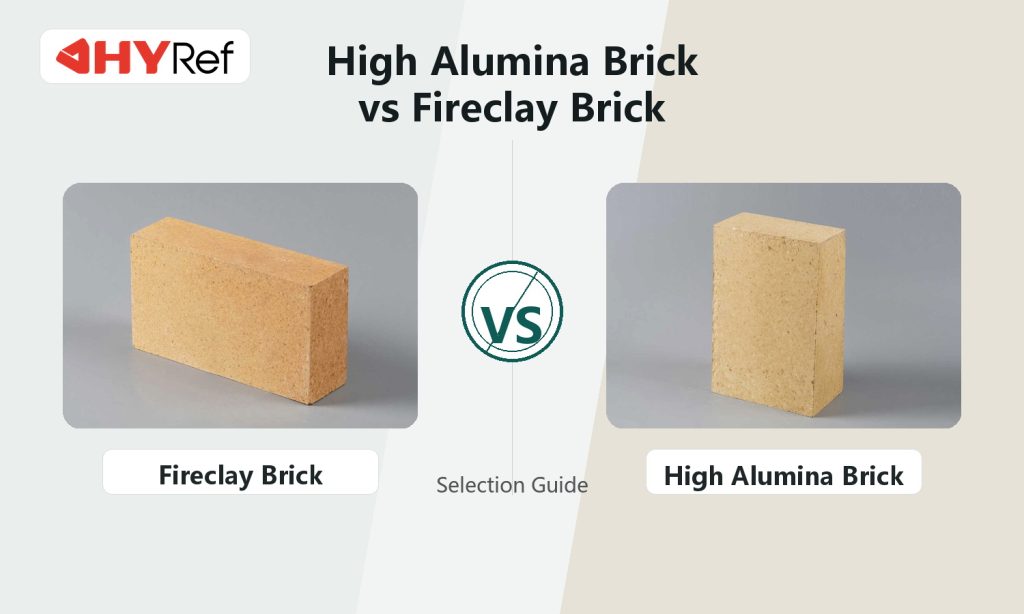
High alumina brick and fireclay brick are both alumina-silica refractory bricks, but they are not selected for the same duty level. Fireclay brick is usually the economical choice for general furnace linings and moderate-duty zones. High alumina brick is the upgrade when the lining needs higher alumina content, stronger refractoriness under load, better wear resistance, and longer service life under more demanding conditions.
The practical question is not “which brick is better?” It is “which brick is enough for this furnace zone?” A low-duty backup lining, a hot-face wall, a rotary kiln transition area, a hot blast stove, and a wear-prone industrial furnace zone do not place the same stress on the brick.
This guide compares high alumina brick vs fireclay brick from a buyer’s point of view: composition, temperature behavior, strength, corrosion resistance, cost, service life, and application fit.
What Is Fireclay Brick?
Fireclay brick is a refractory brick made mainly from refractory clay or chamotte. It belongs to the alumina-silica refractory family and is widely used because it offers practical heat resistance at a relatively economical cost.
Fireclay brick works best when the main requirement is reliable heat resistance, dimensional stability, and reasonable cost. It is often a good fit for zones where chemical corrosion, molten slag, heavy abrasion, and high mechanical load are not the dominant failure causes.
That does not mean all fireclay bricks are low grade. Dense fireclay brick, low-creep fireclay brick, and thermal shock-resistant fireclay brick can be made for different service conditions. But as the furnace zone becomes hotter, more abrasive, or more chemically aggressive, a higher alumina brick or another specialized refractory may become a better technical and economic choice.
If you are still comparing the broader terms “fire brick” and “refractory brick,” start with JHYRef’s guide to refractory brick vs fire brick.
What Is High Alumina Brick?
High alumina brick is an alumina-silica refractory brick made with a higher Al2O3 content than ordinary fireclay brick. In many industrial specifications, high alumina brick starts at about 48% Al2O3 and can increase through several grades for more demanding service.
High alumina brick is commonly used where fireclay brick may be under-specified. Examples include electric arc furnaces, glass melting furnaces, cement rotary kilns, hot blast furnaces, and other industrial furnace areas where heat, load, wear, or chemical attack are more severe.
The main reason to choose high alumina brick is not only a higher temperature number. It is the combined performance package: higher alumina content, better mechanical strength in many grades, stronger resistance to wear, and better stability in harder service. The higher purchase price can be justified when it reduces lining wear, extends shutdown intervals, or prevents premature failure in a critical zone.
High Alumina Brick vs Fireclay Brick: Key Differences
The cleanest way to compare these two bricks is to start with duty level. Fireclay brick is usually the economical general-duty option. High alumina brick is usually the performance upgrade.
| Factor | Fireclay Brick | High Alumina Brick |
|---|---|---|
| Material family | Alumina-silica refractory brick | Higher-alumina alumina-silica refractory brick |
| Typical Al2O3 range on JHYRef pages | 25% to 42% | 48% to 80% |
| Main buyer reason | Economical heat resistance | Higher temperature, strength, wear resistance, and service life |
| Refractoriness under load on JHYRef pages | 1250°C to 1400°C | Listed grades from about 1420°C to 1530°C for standard high alumina grades |
| Cold crushing strength on JHYRef pages | Common listed grades from about 30 MPa to 45 MPa, depending on grade | Common listed grades from about 40 MPa to 70 MPa, depending on grade |
| Typical cost position | Lower | Higher |
| Best use case | General industrial furnaces, backup or moderate-duty linings | Hot-face and higher-duty areas with more heat, load, abrasion, or corrosion |
| Selection risk | Can fail early if used in severe zones | Can be over-specified if the zone only needs economical heat resistance |
This comparison does not mean high alumina brick should replace fireclay brick everywhere. In many furnaces, using high alumina brick in every zone would increase cost without improving the operating result. A good lining design uses the right grade in the right position.
For a brick-focused project, JHYRef can also support custom shapes and grade selection through its capabilities.
When Fireclay Brick Is Usually Enough
Fireclay brick is usually enough when the furnace condition is moderate and the lining does not face severe chemical or mechanical attack. It is especially useful when the project needs a practical balance of heat resistance, availability, workability, and cost.
Choose fireclay brick first when:
– The lining zone is not the most severe hot-face area.
– The operating temperature fits the selected fireclay grade.
– Slag corrosion, alkali attack, and molten metal contact are limited.
– Mechanical abrasion and impact are moderate.
– The buyer needs an economical refractory brick for general service.
– The zone is a backup lining, general furnace wall, or lower-duty area.
– Previous fireclay brick service life was acceptable.
Common examples include general industrial furnace linings, some kiln areas, boilers, heating furnaces, coke oven areas, selected hot blast stove zones, and backup layers behind more severe hot-face refractories.
Fireclay brick can also be useful when maintenance cost is less sensitive than the initial project budget. If a non-critical lining area is easy to inspect and repair, a well-selected fireclay brick may be the rational choice.
The mistake is using fireclay brick only because it is cheaper. If the brick is placed in a zone with strong abrasion, high load, chemical attack, or repeated failure, the lower unit price can disappear quickly through downtime and relining labor.
When High Alumina Brick Is the Better Choice
High alumina brick becomes the better choice when the furnace zone needs more than economical heat resistance. It is often selected when the lining must hold shape, resist wear, and maintain strength under higher temperature or heavier service.
Consider upgrading to high alumina brick when:
– Fireclay brick has worn too quickly in the same zone.
– The furnace area faces higher mechanical load or abrasion.
– The working temperature or refractoriness under load requirement is higher.
– The lining must resist slag or chemical attack better than ordinary fireclay brick.
– The plant wants a longer shutdown interval.
– The cost of early lining failure is high.
– The zone is a hot-face working lining rather than a mild backup layer.
High alumina brick is not automatically the final answer for every severe condition. For basic slag, steel ladle slag lines, copper smelting furnaces, glass corrosion, or strongly reducing atmospheres, other refractory systems may be required. Magnesia, magnesia chrome, magnesia carbon, corundum, silicon carbide, or other specialty products may be better, depending on the chemistry.
But when the real choice is between fireclay brick and high alumina brick within an alumina-silica brick system, high alumina brick is usually the stronger option for performance-sensitive zones.
Application Comparison by Furnace Zone
| Furnace or Zone | Fireclay Brick Fit | High Alumina Brick Fit |
|---|---|---|
| General furnace wall | Often suitable if conditions are moderate | Better when temperature, wear, or load is higher |
| Backup lining | Often suitable when insulation is not the main requirement | Sometimes unnecessary unless the backup layer sees high load or heat |
| Hot-face working lining | Suitable only in moderate-duty service | Often better for higher-duty alumina-silica lining areas |
| Cement kiln zones | Possible in less severe zones | Often considered for hotter or more abrasive zones, depending on full kiln chemistry |
| Hot blast stove | Fireclay grades may fit selected areas | Low-creep high alumina grades may fit more demanding areas |
| Glass or ceramic kiln | Can work in general zones | Better for higher-temperature or stronger service zones |
| Wear-prone industrial furnace area | May wear too quickly | Often stronger choice if chemistry is compatible |
The final choice depends on operating temperature, peak temperature, lining position, fuel, atmosphere, process material, slag chemistry, thermal cycling, and failure history.
Can High Alumina Brick Replace Fireclay Brick?
High alumina brick can often replace fireclay brick when the project needs higher performance and the chemistry is compatible. The upgrade may improve strength, refractoriness under load, wear resistance, and service life in many alumina-silica applications.
However, replacement should not be automatic. High alumina brick may have different thermal expansion behavior, cost, density, and installation requirements. The furnace design, existing lining structure, mortar, joint thickness, and thermal cycling pattern should be checked before changing grades.
The most common reason to replace fireclay brick with high alumina brick is repeated early failure. If the fireclay lining shows excessive wear, deformation, spalling, or hot-face damage, high alumina brick may be worth evaluating. But the failure cause must be understood first. If the root cause is basic slag attack, poor drying, incorrect anchoring, mechanical impact, or thermal shock beyond the grade’s design, a simple alumina upgrade may not solve the problem.
In other words, high alumina brick is a logical upgrade inside the alumina-silica family, but it is not a universal repair for every refractory failure.
Can Fireclay Brick Replace High Alumina Brick?
Fireclay brick should replace high alumina brick only when the furnace zone is clearly mild enough for the lower-duty material. This may happen in backup linings, lower-temperature areas, less abrasive sections, or projects where the previous high alumina grade was over-specified.
The risk is under-specification. If a high alumina brick was originally used because the zone has higher load, high temperature, abrasion, or longer service-life requirements, switching to fireclay brick may reduce lining life and increase shutdown frequency.
Before downgrading from high alumina brick to fireclay brick, check:
1. Actual working temperature and peak temperature.
2. Lining position and hot-face exposure.
3. Abrasion, dust, clinker, ash, or material impact.
4. Slag, alkali, or chemical exposure.
5. Existing service life and failure pattern.
6. Cost of shutdown compared with brick cost savings.
If the current lining already performs well, downgrading only to reduce brick price can be risky. A lower-cost brick is only economical if it still meets the service-life target.
What Information Should You Send?
Send these details when requesting a quotation:
– Furnace, kiln, or equipment type.
– Lining position, such as wall, roof, bottom, burner zone, transition zone, or backup layer.
– Normal working temperature and peak temperature.
– Furnace atmosphere and fuel type.
– Process material, slag, dust, clinker, glass, metal, ash, or chemical exposure.
– Thermal cycling frequency.
– Mechanical wear, impact, or load condition.
– Current lining material and failure problem, if replacing an old lining.
– Required brick size, drawing, shape, and tolerance.
– Quantity, packaging, destination, and delivery schedule.
– Service-life target or planned shutdown cycle.
For JHYRef, this information helps decide whether the project should use fireclay brick, high alumina brick, or a different refractory material entirely.
FAQ
The main difference is alumina content and duty level.Higher alumina content is usually associated with stronger high-temperature performance.
Use fireclay brick when the lining needs economical heat resistance and the working condition is not severely corrosive, abrasive, or heavily loaded. It is often suitable for general industrial furnaces, moderate-duty zones, selected kiln areas, and backup linings.
Use high alumina brick when the furnace zone has higher temperature, load, abrasion, or service-life demands. It is commonly considered for hot-face working linings, cement kilns, glass melting furnaces, electric arc furnaces, hot blast furnaces, and other higher-duty areas.
Fireclay brick is usually cheaper than high alumina brick. But the better economic choice depends on total service cost. If high alumina brick extends lining life and reduces shutdowns in a severe zone, it may be more economical over the full campaign.
Conclusion
The high alumina brick vs fireclay brick decision is really a duty-level decision. Fireclay brick is often the practical choice for general heat resistance, moderate-duty linings, and cost-sensitive projects. High alumina brick is the stronger choice when the furnace zone needs higher refractoriness under load, better strength, improved wear resistance, and longer service life.
Before choosing, define the furnace zone clearly. Ask what the brick must resist: heat, load, abrasion, slag, chemical attack, thermal cycling, or a combination of these factors. Then compare the brick grade against those conditions.
If you already have a specific refractory brick in mind, send JHYRef the brick type, size or drawing, required quantity, and destination port, and we can provide a quotation based on your requirements.
If you are replacing failed bricks or considering a different refractory lining configuration, share your furnace type, operating temperature, lining position, current failure photos, and working conditions. Our team can then recommend a suitable refractory brick solution, such as fireclay brick, high alumina brick, or another material better matched to the actual service environment.