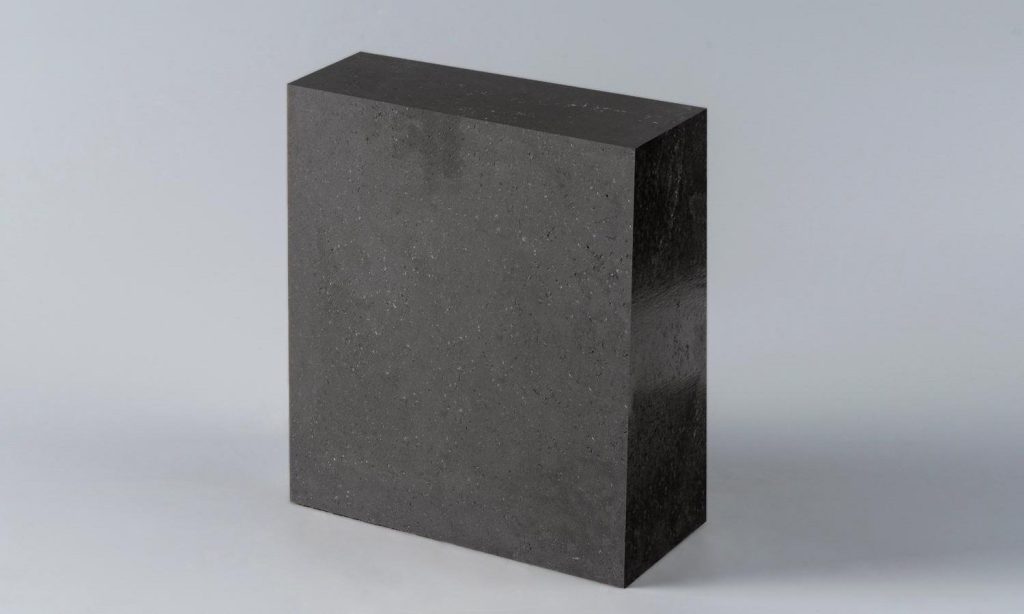
Magnesia carbon brick is a non-burning MgO-C refractory made from high-purity magnesia, graphite, carbon binder, and antioxidants. It is mainly used in converter slag lines, electric arc furnace hot spots, ladle slag lines, hot metal ladles, torpedo cars, and other severe steelmaking zones where slag corrosion, thermal shock, and steel penetration must be controlled.
What Is Magnesia Carbon Brick?
Magnesia carbon brick, often called MgO-C brick, is a carbon composite refractory produced from magnesia, graphite, carbonaceous binder, and performance additives. Unlike fired magnesia brick, it is usually resin bonded and heat treated rather than fully fired at high temperature.
The material was developed because traditional magnesia brick has strong high-temperature and basic slag resistance, but weaker thermal shock resistance and slag penetration resistance. Adding graphite changes that balance. Graphite has high thermal conductivity, low thermal expansion, and poor wettability by molten slag and molten steel. That helps MgO-C brick resist cracking, spalling, and slag penetration in steelmaking operations.
This combination makes magnesia carbon brick especially useful in furnace zones where a lining must handle several attacks at the same time: high temperature, slag corrosion, molten steel contact, rapid temperature change, oxygen exposure, and mechanical wear.
For detailed product grades and specifications, see JHYRef’s magnesia carbon brick specifications.
Why Magnesia and Carbon Work Together?
Magnesia and carbon solve different parts of the same refractory problem.
Magnesia, or MgO, has a very high melting point and strong resistance to basic slag. That makes it suitable for steelmaking environments where lime-rich slag can quickly attack acidic or alumina-silica refractories.
Graphite brings another set of benefits. It does not wet easily with molten steel or slag, so it helps reduce penetration into the brick structure. It also conducts heat well and expands very little, which helps reduce thermal stress during rapid heating, tapping, refining, and cooling.
Together, MgO and carbon create a refractory that can resist slag, handle thermal cycling, and maintain lining stability in severe service. The tradeoff is that carbon can oxidize. That is why antioxidants and proper grade selection are important, especially in oxidizing furnace zones.
Key Magnesia Carbon Brick Properties
The right magnesia carbon refractory brick should be evaluated by both chemistry and service behavior. A higher number on one specification does not automatically mean better performance in every furnace zone.
| Property | Why It Matters | Buyer Check |
|---|---|---|
| MgO content | Supports basic slag resistance and refractoriness | Request chemical composition by grade |
| Carbon content | Improves thermal shock resistance and reduces slag wetting | Match carbon level to furnace zone and oxidation risk |
| Apparent porosity | Affects slag and steel penetration | Lower porosity is usually preferred in severe zones |
| Bulk density | Indicates compactness and structural integrity | Compare with application requirements |
| Cold crushing strength | Shows room-temperature mechanical strength | Useful for handling and installation checks |
| Hot modulus of rupture | Indicates hot strength under service conditions | Important for slag line and hot spot zones |
| Oxidation resistance | Helps protect graphite during high-temperature service | Ask about antioxidant system and application fit |
High-Temperature Resistance
MgO gives magnesia carbon brick excellent refractoriness. In steelmaking, this matters because the lining must keep its structure while exposed to molten steel, basic slag, arc radiation, or oxygen blowing.
Slag Corrosion and Penetration Resistance
Basic slag can dissolve refractory oxides and carry reaction products into the brick structure. Graphite helps by reducing wetting and penetration. This is one reason MgO-C brick is widely used in slag lines, where slag contact is continuous or repeated.
Thermal Shock Resistance
Thermal shock is a major cause of cracking and spalling. Graphite’s high thermal conductivity and low thermal expansion help the brick handle sudden temperature changes better than pure magnesia brick.
Oxidation Resistance
Carbon oxidation is the weak point of MgO-C refractories. At high temperature, graphite can react with oxygen, oxidizing slags, or iron oxides. Once carbon is lost, porosity rises and slag can penetrate more easily. Antioxidants help slow this process, but the right formulation depends on furnace atmosphere and lining zone.
Failure Mechanisms of Magnesia Carbon Bricks
Magnesia carbon brick failure is usually caused by combined wear, not one isolated problem. A brick may begin with carbon oxidation, then slag penetrates the decarburized layer, then thermal cycling or mechanical erosion accelerates loss.
Carbon Oxidation
Graphite can oxidize at high temperature when exposed to oxygen in air, oxygen blowing, oxidizing slag, or metal oxides. Oxidation removes carbon from the hot face, increases porosity, weakens the structure, and makes it easier for slag to penetrate.
Antioxidants are added to improve long-term performance, but they must match the operating environment. A high-oxidation zone needs different protection than a more stable reducing area.
Slag Corrosion and Penetration
Slag can chemically react with MgO and physically penetrate pores and cracks. Once slag enters the brick, it can alter the structure and create a weakened reaction layer. This is especially common in slag lines and hot spots.
The best defense is not simply “more carbon” or “more MgO.” It is the right combination of raw material quality, porosity control, carbon content, antioxidant system, and application fit.
Thermal Shock and Spalling
Rapid heating and cooling can create thermal stress. Graphite helps reduce this risk, but spalling can still occur if the brick is exposed to severe cycling, poor installation, uneven heating, or sudden process changes.
Mechanical Erosion and Installation Issues
Furnace operation can also damage MgO-C brick through impact, abrasion, scraping, poor joint design, loose lining, or local hot spots. If wear is uneven, photos and lining drawings are often more useful than a simple material name.
Magnesia Carbon Brick Applications
Converter slag line
This area is exposed to high temperature and strong erosion from basic slag.
MgO provides strong resistance to basic slag corrosion.
Carbon reduces slag wettability and prevents penetration.
Good thermal shock resistance also reduces spalling, significantly extending furnace life.
Electric arc furnace wall hot spots
This area faces extreme thermal shock, slag corrosion, and frequent temperature fluctuations.
High refractoriness (MgO melting point ~2852°C), combined with carbon’s high thermal conductivity and low expansion, helps reduce thermal stress and spalling.
Ladle slag line
This area is in long-term contact with the steel-slag interface.
It experiences large temperature differences, penetration, and oxidation.
Magnesia-carbon bricks have low wettability to slag and steel, strong anti-penetration ability, and good resistance to corrosion and spalling.
They are especially suitable for continuous casting operations.
Converter lining
These parts endure high-temperature molten bath, mechanical impact, and slag attack.
Magnesia-carbon bricks are suitable due to their combined high-temperature resistance, slag resistance, and thermal shock resistance.
They improve the overall service life of the equipment.
How to Choose Magnesia Carbon Brick
The right magnesia carbon brick depends on the furnace and the wear mechanism. Before selecting a grade, review these factors:
1. Furnace type: BOF converter, EAF, ladle, hot metal ladle, torpedo car, or another steelmaking vessel.
2. Furnace zone: slag line, sidewall, hot spot, barrel, bottom, impact zone, or repair area.
3. Slag chemistry: basicity, FeO content, fluidity, refining slag type, and aggressiveness.
4. Operating temperature: average temperature, peak temperature, and thermal cycling frequency.
5. Atmosphere and oxidation risk: oxygen blowing, air exposure, preheating practice, and oxidizing slag.
6. Carbon content target: low carbon, standard carbon, or high carbon based on thermal shock and oxidation balance.
7. MgO source: sintered magnesia or fused magnesia depending on performance target.
8. Current lining performance: service life, wear rate, infiltration depth, cracking, spalling, and repair history.
9. Maintenance plan: full relining, partial repair, emergency replacement, or performance upgrade.
For many buyers, the fastest way to avoid a mismatch is to send the current working condition before asking for price. A cheaper brick can become expensive if it fails early in the wrong zone.
What Technical Data Buyers Should Request
Before ordering magnesia carbon bricks, ask for a technical data sheet and confirm the grade fits the application. At minimum, buyers should request:
– MgO content
– Carbon content
– Apparent porosity
– Bulk density
– Cold crushing strength
– Hot modulus of rupture
– Oxidation resistance information
– Recommended application zone
– Brick dimensions and tolerances
– Special shape capability
– Packaging and delivery details
– Test report or quality documentation when required
For international projects, also confirm the applicable testing method or standard used for each value. Comparing data from different suppliers is only useful when the test basis is clear.
If the working condition needs a related carbon composite refractory rather than standard MgO-C brick, JHYRef can also review magnesia alumina carbon brick or alumina magnesia carbon brick options based on furnace zone and slag condition.
FAQ
Magnesia carbon brick is made from high-purity magnesia, graphite, carbonaceous binder, and performance additives such as antioxidants. It is a non-burning carbon composite refractory used in severe steelmaking zones.
There is no universal best carbon content. Higher carbon can improve thermal shock resistance and slag non-wettability, but it can also increase oxidation risk and thermal conductivity. The right carbon level depends on furnace zone, oxidation condition, slag chemistry, and service target.
MgO-C brick oxidizes because graphite reacts with oxygen, oxidizing slags, or metal oxides at high temperature. Oxidation creates a decarburized layer, increases porosity, weakens the hot face, and allows deeper slag penetration.
Magnesia carbon brick is commonly used in converter slag lines, EAF hot spots, EAF sidewalls, ladle slag lines, hot metal ladles, torpedo cars, and other high-temperature metallurgical equipment exposed to slag corrosion and thermal shock.
Conclusion
Magnesia carbon brick is one of the most important refractory materials for modern steelmaking because it combines MgO’s basic slag resistance with graphite’s thermal shock resistance and low slag wettability. But the grade matters. A converter slag line, an EAF hot spot, and a ladle slag line may all use MgO-C brick, yet each zone needs a different balance of MgO purity, carbon content, density, oxidation resistance, and hot strength.
If your company is looking for high-performance and long-life magnesia-carbon brick solutions, or needs customized selection for converters, ladles, or other working conditions, please feel free to contact us.
We will provide professional differential selection suggestions, product solutions, and on-site technical support based on your furnace type, slag system, and process conditions. We help improve furnace life and reduce refractory consumption.
JHYRef is committed to innovative and green development. We look forward to working with more steel enterprises to explore new low-carbon and high-efficiency refractory application pathways.