To choose magnesia chrome brick, start with the furnace zone and failure mechanism, not only MgO or Cr2O3 content. The right grade depends on furnace type, working temperature, slag chemistry, atmosphere, corrosion, erosion, thermal cycling, lining position, and whether the project requires a chrome-free refractory.
Non-ferrous copper and lead smelting furnaces, AOD refining furnaces, RH furnaces, and glass furnace regenerators may all use basic refractory materials, but the suitable choice is not the same brick in every case. The truly right choice is the brick that matches the actual operating conditions and the target service life.
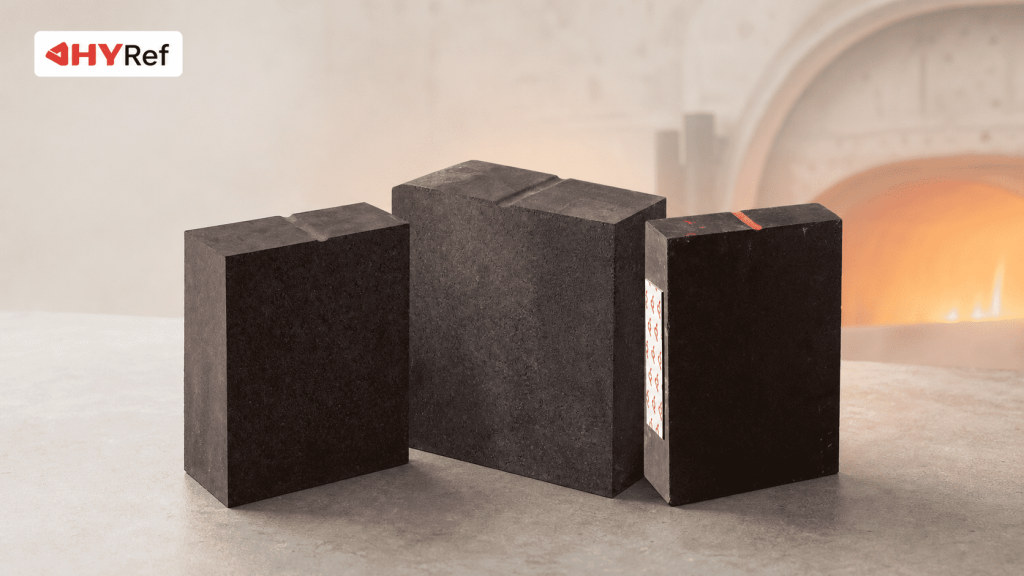
Start With the Furnace Conditions
Before comparing grade tables, define the working environment. Magnesia chrome brick is selected for severe high-temperature service, but “severe” can mean different things in different furnaces.
Ask these questions first:
1. What furnace or kiln is it?
2. Which lining position needs the brick?
3. What is the normal working temperature and peak temperature?
4. Is the atmosphere oxidizing, reducing, neutral, or changing?
5. What slag or process material contacts the brick?
6. Is the main damage corrosion, erosion, spalling, cracking, slag penetration, or mechanical wear?
7. How often does the furnace heat up and cool down?
8. Is the lining exposed to impact, abrasion, or load?
9. What service life do you expect before shutdown?
10. Are chrome-containing refractories restricted in this project?
This step prevents the most common purchasing mistake: choosing a brick by name or price before understanding the service zone.
For example, a cement kiln transition zone may need coating compatibility and thermal cycling resistance. A non-ferrous smelting furnace may need stronger slag corrosion resistance.
A glass furnace regenerator may need long-term stability under gas flow and temperature cycling. Those are different selection problems.
Understand the Main Types of Magnesia Chrome Brick
Magnesia chrome brick is a basic refractory brick made mainly from MgO and Cr2O3. Its key mineral phases include periclase and magnesia-chromite spinel. However, different production routes and raw materials create different performance levels.
| Type | Main Feature | Best-Fit Applications |
|---|---|---|
| Common magnesia chrome brick | General MgO-Cr2O3 refractory | Standard high-temperature basic refractory lining |
| Direct bonded magnesia chrome brick | Lower impurity and stronger periclase-spinel bonding | Cement kiln, glass regenerator, refining furnace |
| Semi-rebonded magnesia chrome brick | Higher-grade structure and stronger corrosion resistance | Areas requiring both thermal shock resistance and slag erosion resistance |
| Fused rebonded magnesia chrome brick | Dense structure and strong slag resistance | Copper smelting and severe slag attack zones |
Common magnesia chrome brick can fit general high-temperature service where the working condition is not extremely aggressive. It is often chosen when the project needs basic refractory performance but does not require the highest density or strongest bonding structure.
Direct bonded magnesia chrome brick is usually selected when the furnace requires lower impurity content, stronger high-temperature bonding, lower porosity, and better slag resistance. This type is useful when ordinary magnesia chrome brick is not enough but the application does not necessarily require fused rebonded material.
Semi-rebonded and fused rebonded grades are more suitable for severe corrosion and erosion. They are often considered in non-ferrous metallurgy and heavy slag attack zones, where dense structure and stronger corrosion resistance can justify higher material cost.
Match the Brick to the Application
The right grade direction becomes clearer when you map the brick to the furnace application.
| Application | Working Condition | Grade Direction |
|---|---|---|
| Cement rotary kiln | Clinker attack, coating behavior, alkali, thermal | Direct bonded or suitable basic refractory grade; check chrome-free requirements |
| Glass furnace regenerator | High temperature, furnace gas, checker/regenerator cycling | Direct bonded or selected magnesia chrome grade after zone review |
| Non-ferrous smelting furnace | Aggressive slag, molten phases, corrosion and erosion | Semi-rebonded, fused rebonded magnesia chrome direction |
| Copper smelting furnace | Severe slag attack | Fused rebonded or high corrosion-resistant magnesia chrome direction |
| AOD, VOD, RH refining | High temperature, slag, erosion, secondary refining conditions | Direct bonded or specialized Mg-Cr grade by zone |
| Electric furnace / industrial kiln | Heat, wear, slag or gas exposure varies by process | Select by atmosphere, slag chemistry, lining position, and wear pattern |
For non-ferrous smelting, JHYRef’s article on copper smelting furnace refractory selection gives useful context on directly bonded, semi-rebonded, and fused rebonded magnesia chrome brick directions.
For cement kilns, selection must be more cautious. Magnesia chrome brick has been used in burning zones, but some projects now prefer chrome-free alternatives because of environmental rules and used-refractory handling. Always confirm local policy before choosing chrome-containing refractory.
Read Technical Data the Right Way
Technical data should help you predict service behavior. It should not be treated as a decorative product table. When choosing magnesia chrome brick, compare these properties:
| Technical Data | What It Tells You |
|---|---|
| MgO content | Basic refractory performance and high-temperature stability |
| Cr2O3 content | Spinel formation and slag resistance direction |
| SiO2 and impurity content | Not conducive to resisting slag erosion |
| Apparent porosity | Lower porosity usually improves resistance to slag penetration |
| Bulk density | Higher density often supports stronger structure and penetration resistance |
| Cold crushing strength | Room-temperature mechanical strength before installation |
| Refractoriness under load | Resistance to deformation under heat and load |
| Thermal shock resistance | The ability to resist sudden temperature changes |
| Dimensional tolerance | Installation accuracy and lining tightness |
Do not choose by Cr2O3 content alone. Higher Cr2O3 may help in some corrosion conditions, but the total structure matters: raw material quality, firing temperature, porosity, bonding, density, and application fit all affect performance.
Likewise, do not choose by maximum temperature alone. A brick that handles high temperature may still fail early if the slag chemistry, atmosphere, or mechanical wear does not match the material.
Choose by Failure Mode
If you are replacing a failed lining, the failure pattern is one of the best clues.
If the brick was heavily corroded or penetrated by slag, focus on grade density, porosity, Cr2O3 direction, direct bonding, and whether a semi-rebonded or fused rebonded grade is needed.
If the brick cracked or spalled, check thermal shock resistance, heating/cooling frequency, installation joints, expansion allowance, and whether the current model is not suitable for this frequency of temperature changes.
If the brick was eroded or mechanically worn, check furnace material flow, abrasion, impact, cold crushing strength, and whether another refractory type may be better.
If the lining deformed under load, review refractoriness under load, load-bearing position, temperature, and brick grade.
If a cement kiln lining has environmental restrictions, evaluate magnesia chrome brick against chrome-free refractories such as magnesia alumina spinel brick where appropriate.
This failure-mode approach is more useful than simply asking for “the best magnesia chrome brick.” The best grade is the one that solves the actual damage mechanism.
FAQ
There is no single best magnesia chrome brick for every industrial furnace. The right grade depends on furnace type, lining position, temperature, slag chemistry, atmosphere, wear pattern, thermal cycling, and environmental requirements.
Choose direct bonded magnesia chrome brick when the lining needs stronger periclase-spinel bonding and better corrosion resistance than common magnesia chrome brick can provide.
Fused rebonded magnesia chrome brick is usually considered for severe corrosion and slag attack, especially in demanding non-ferrous smelting or copper smelting furnace zones. Confirm the need by checking slag chemistry, erosion, and service-life target.
Magnesia chrome brick has been used in cement rotary kiln burning zones. However, cement kiln buyers should also check clinker chemistry, coating behavior, thermal cycling, environmental policy, and chrome-free refractory alternatives.
Yes. Magnesia chrome brick can be produced in standard sizes and special shapes according to drawings. Send the brick dimensions, tolerance, quantity, and application condition for confirmation.
Conclusion
Choosing magnesia chrome brick is an engineering decision, not just a catalog decision. Start with the furnace zone, working temperature, slag chemistry, atmosphere, wear pattern, and failure mode. Then compare common, direct bonded, semi-rebonded, and fused rebonded grades against the actual service condition.
JHYRef supplies refractory bricks, castables, special shaped bricks, insulation materials, refractory mixes, precast parts, and technical support for industrial furnace projects.