
The rotary kiln is the core reaction zone of the Waelz process. JHYRef delivers engineering-driven solutions that integrate design, application, operational analysis, and optimization to ensure reliable lining performance under extreme conditions of 1200°C–1300°C. Our objective is to maximize kiln operational stability while minimizing total cost of ownership (TCO).
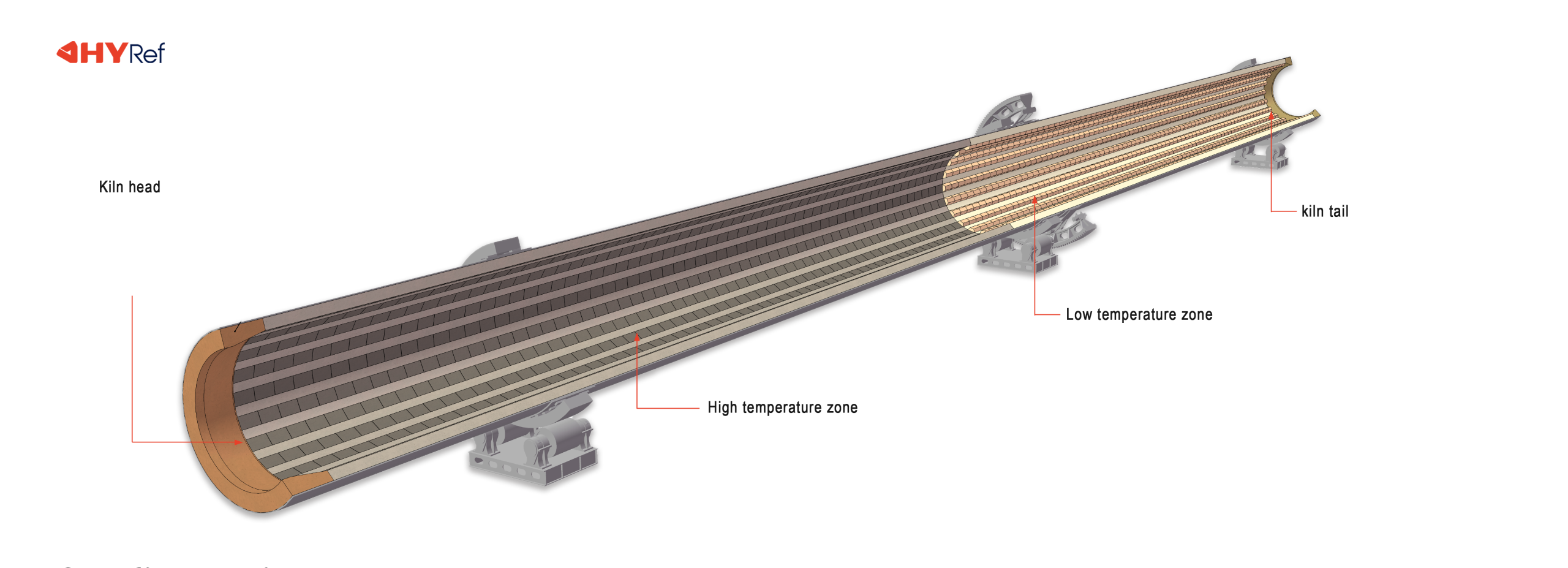
Multi-Dimensional Configuration & Selection
Quick Selection
| Configuration | Primary Application | Core Value |
| 01 Optimized | Steel Plant Waste (EAF/BOF/BF Dust) | Wear-Resistant & Process-Fit |
| 02 Corrosion-Resistant | Leaching Residue Treatment | Basic Erosion & Accretion Control |
| 03 Energy-Efficient | High Shell Temp. Operations | Major Temp. Drop & Thermal Management +1 |
| 04 Fast-Track & Eco | Tight Construction Schedule | Rapid Installation & Double Efficiency +1 |
Configuration 1: Optimized Lining System for Low-Zinc Waelz Operations
- Enhanced Wear Resistance with Thermal Stability: High-strength phosphate-bonded refractory systems are applied within the kiln, with heat-resistant steel fiber reinforcement introduced at the kiln head and tail to withstand heavy material impact and scouring.
- Predictable Maintenance: Differentiated material selection across kiln zones promotes balanced wear distribution, improving the reliability of scheduled shutdown planning.
Configuration 2: Optimized Lining System for Leaching-Residue Waelz Operations
- Corrosion-Dominant with Enhanced Wear Resistance: Mg–Al–Cr bricks are applied in the high-temperature zone to effectively resist complex chemical attack, particularly from alkaline slags, while maintaining strong resistance to material scouring.Under leaching-residue operating conditions, the service life of this system is typically significantly longer than that of phosphate-bonded wear-resistant linings.
- Ring Formation Control Capability: The selected refractory system helps mitigate accretion issues under high ring-formation risk conditions, reducing the frequency of burn-down or mechanical ring removal operations.
- Zoned Configuration with Predictable Maintenance: Differentiated material selection across kiln zones promotes balanced wear distribution, improving the reliability of scheduled shutdown planning.
Configuration 3: Energy-Efficient Lining System for Waelz Operations
- Shell Temperature Control with Maintained Durability: The integrated lining structure effectively reduces kiln shell temperature—typically by 50–80°C under comparable operating conditions—thereby reducing energy loss while preserving wear resistance and thermal-shock stability.
- Zoned Thermal Optimization: Targeted insulation and structural reinforcement are applied according to the thermal and mechanical load distribution along different kiln sections, enabling improved control of overall kiln heat balance.
- Cost-Effective Operation: Reduced fuel consumption and heat loss contribute to lower operating costs; The monolithic structure also helps minimize unplanned shutdown risk and enhances maintenance predictability.
Configuration 4: Fast-Track & Energy-Efficient Lining System for Waelz Operations
- Energy-Oriented Design with Accelerated Installation: The combined use of castables and prefabricated components effectively reduces kiln shell temperature while significantly shortening on-site construction time compared with fully monolithic lining systems.
- Shell Temperature Control with Maintained Performance: Under comparable operating conditions, the hybrid lining structure typically reduces shell temperature by 50–80°C, minimizing energy loss while preserving wear resistance and thermal-shock stability.
- Flexible Zoned Adaptation: Castables and prefabricated elements are strategically combined according to thermal and mechanical load distribution across kiln sections, achieving an optimized balance between insulation performance, structural strength, and installation efficiency.
Contact us for detailed configuration and technical specifications: Request Quote