
The anode refining converter is a mainstream refining unit in modern copper smelting. It mainly receives blister copper from the PS converter and deeply purifies it through oxidation for impurity removal and reduction for deoxidation, producing anode copper plates with a grade of ≥99.5% for subsequent electrolysis to produce cathode copper.
The refining temperature inside the furnace is controlled at 1150°C to 1200°C. The tuyere area, burner area, furnace mouth, and slag line are the main lining wear zones. High-grade magnesia-chrome bricks or alumina-chrome bricks are recommended for the tuyere and burner areas; high-quality magnesia-chrome bricks are used for the furnace mouth and slag line; and standard magnesia-chrome bricks are used for the remaining furnace body areas.
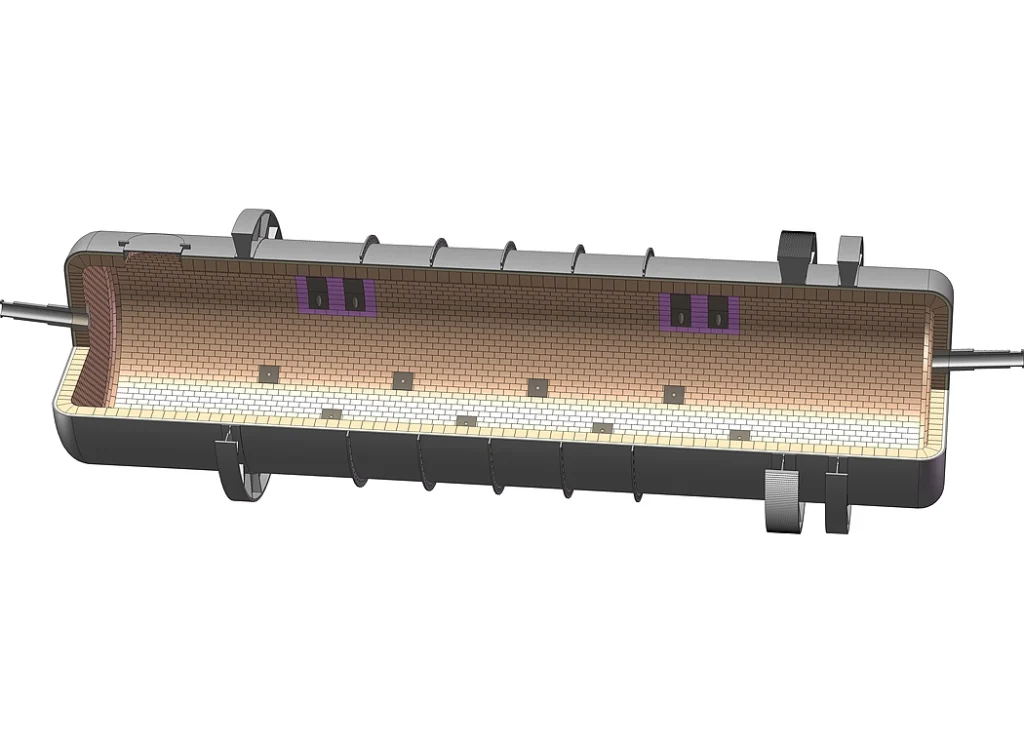
Selection Criteria for Anode Furnace Lining Materials
A copper anode furnace refines blister copper or high-grade secondary copper into anode copper for electrorefining. During operation, the lining is exposed to intermediate to high temperature, changing oxidizing and reducing atmospheres, copper bath contact, slag contact in selected areas, burner heat, tuyere or refining gas movement, and repeated heating and cooling.
This is different from choosing one general furnace-wall refractory. The barrel may face redox cycling and copper oxide infiltration. The slag line faces stronger corrosion and penetration. The mouth area may be damaged by cleaning, collar removal, thermal shock, and mechanical impact. Burner and tuyere areas see localized stress that cannot always be solved with a standard brick shape.
Conclusion
We provide lining design, material selection, and on-site technical support for anode furnace operating conditions. Contact our technical team to discuss your requirements.