
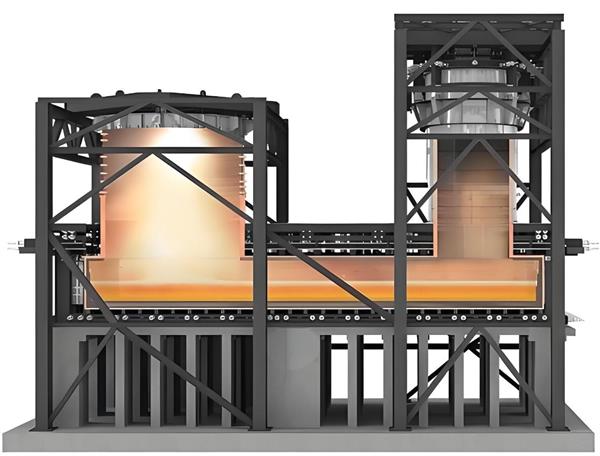
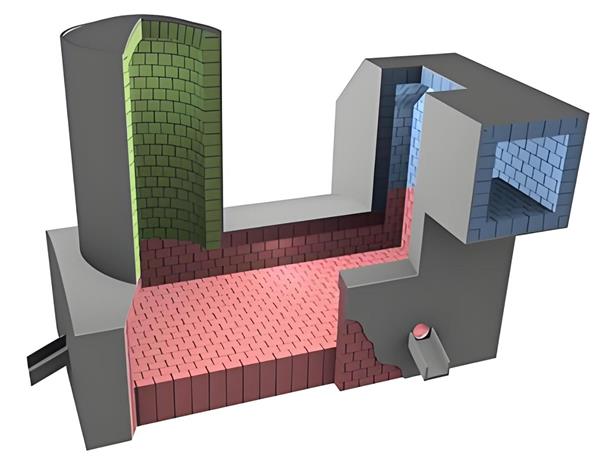
Flash smelting furnace process: deeply dried copper concentrate, flux, and auxiliary materials are injected at high speed into the vertical reaction shaft through the roof burner together with oxygen-enriched air of different concentrations. In a high-temperature suspended state, the materials undergo rapid oxidation and heat release, enabling autogenous smelting. The flash reaction produces copper matte, iron silicate slag, and SO2 gas. The molten products fall into the settler, where they are kept hot, settle, and separate into layers. The lower layer of high-grade matte is sent to the converter for converting, while the upper slag layer is discharged. High-temperature off-gas containing a high concentration of SO2 exits through the uptake shaft and enters the downstream acid-making process.
Why Flash Smelting Furnaces Need Specialized Refractories
A flash smelting furnace handles fine copper concentrate, flux, oxygen-enriched air, matte, slag, and high-temperature gas flow in a compact, severe process environment. The lining has to resist more than temperature. It must handle chemical attack, molten material movement, gas-phase corrosion, infiltration, abrasion, and thermal stress at the same time.
This is why a generic refractory recommendation can fail. A material that performs well in a relatively stable high-temperature wall area may not survive in the slag line. A repair castable that works for one shutdown window may be unsuitable if it is not compatible with the existing brick lining or heating schedule.
For flash smelting furnace refractory selection, the practical question is not “which brick is best?” The better question is “which material matches this exact zone, chemistry, temperature, and maintenance target?”
“A flash smelting furnace lining should be checked by working zone first, because the reaction shaft, settler, and slag line do not fail in the same way.”JHYRef Refractory Engineering Team
Recommended Refractory Materials
Magnesia-chrome bricks are a core material direction for severe copper smelting furnace zones. In flash smelting furnace applications, they may be used in the reaction shaft, high-temperature settler areas, slag line zones, and other areas where slag corrosion resistance and thermal stability are required.
How to Choose Flash Smelting Furnace Refractory
The right flash smelting furnace refractory system depends on the main wear mechanism in each area. A slag-line problem is different from a reaction-shaft problem. A settler penetration issue is different from local repair around worn joints.
Key selection factors include:
– Furnace zone: reaction shaft, lower shaft, settler, slag line, roof, transition, or repair zone.
– Operating temperature: severe high-temperature service can combine with chemical and mechanical wear.
– Slag chemistry: FeO-SiO2 slag and related copper smelting melts can strongly affect corrosion behavior.
– Matte contact: matte and slag movement can cause penetration, erosion, and structural damage.
– Gas atmosphere: SO2 gas and oxygen-rich process conditions can contribute to chemical attack.
– Thermal cycling: shutdowns, startups, and process adjustments can create cracking or spalling risk.
– Existing lining performance: current service life and failure pattern show whether the issue is corrosion, penetration, thermal shock, abrasion, or installation-related.
– Chrome-free requirement: spinel options may be possible, but only after checking the exact condition.
– Maintenance target: campaign length, shutdown window, and repair method affect material selection.
“When slag chemistry, gas atmosphere, and lining photos are reviewed together, material selection becomes more accurate than choosing only by temperature rating.” JHYRef Technical Team
What JHYRef Needs Before Quoting
For a practical refractory recommendation, send more than the furnace name. Complete operating data helps JHYRef avoid a generic quote and prepare a material direction that fits the actual wear condition.
Please provide:
1. Furnace area: reaction shaft, settler, slag line, roof, transition, or repair zone.
2. Working temperature and temperature fluctuation.
3. Slag composition or process information.
4. Matte and slag contact condition.
5. Current refractory material and service life.
6. Damage photos showing thinning, cracking, penetration, spalling, or joint wear.
7. Drawings, lining thickness, dimensions, and special brick shapes if available.
8. Installation method, shutdown schedule, and restart timing.
9. Required quantity, delivery destination, and project deadline.
This information helps JHYRef recommend a suitable refractory lining system instead of quoting a generic product.
Conclusion
Whether you are conducting the initial lining selection for a new build project or upgrading the slag and penetration resistance of an operating furnace, simply provide your design drawings or operational parameters, and the JHYRef technical team will provide a quantified material configuration assessment within 72 hours.