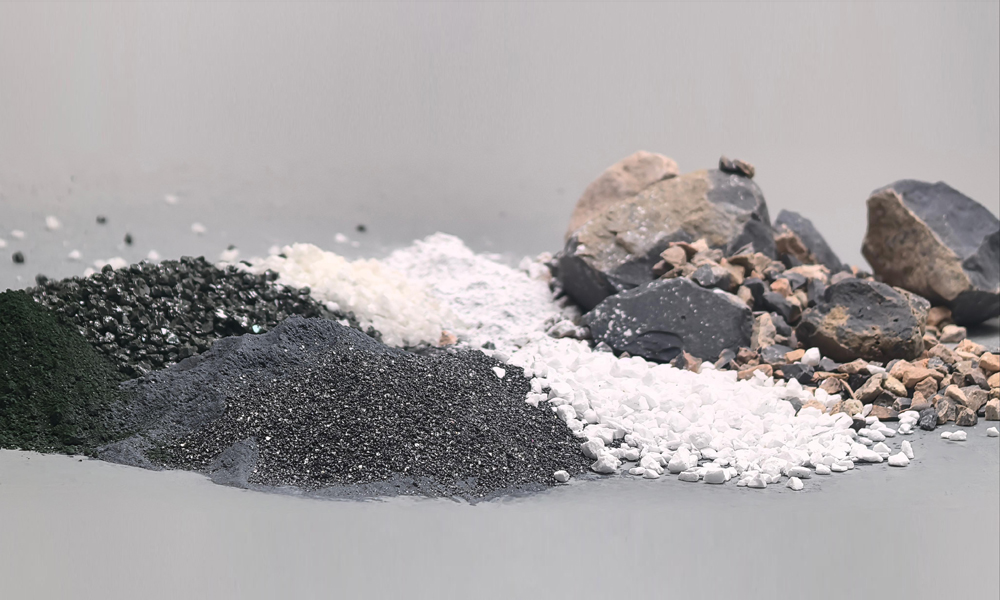
Refractory raw materials are the foundation of refractory products. They provide the chemical composition, mineral phase, particle structure, bonding behavior, and high-temperature properties that allow refractory bricks, castables, mortars, ramming masses, and other materials to work in kilns and furnaces.
It explains their main components, sources, basic features, and typical refractory products.
What Are Refractory Raw Materials?
Refractory raw materials are mineral or synthetic materials used to manufacture refractories. In finished refractory products, they may function as aggregates, fine powders, binders, additives, or special performance phases.
Aggregates form the main skeleton of a refractory product. Fine powders fill spaces between aggregates and support sintering or bonding. Binders provide shaping strength, installation strength, or fired strength. Additives can improve workability, drying, oxidation resistance, volume stability, or other properties.
The same raw material may be used in different product forms. For example, alumina-rich materials can be used in high alumina brick, alumina castable, corundum castable, mortar, or prefabricated shapes. Magnesia can be used in magnesia brick, magnesia carbon brick, magnesia ramming mass, and other basic refractories.
General refractory references, including Britannica’s refractory overview, classify refractories by composition and performance, with common systems including silica, aluminosilicate, alumina, magnesia, chrome, zirconia, carbide, and carbon-containing materials.
Quick Overview of Common Refractory Raw Materials
| Raw material category | Main component | Common source or form | Typical refractory products |
|---|---|---|---|
| Siliceous raw materials | SiO2 | quartzite, quartz, silica sand, fused silica | silica brick, silica mortar, siliceous castable |
| Clay-based raw materials | Al2O3-SiO2 | refractory clay, hard clay, soft clay, kaolin | fireclay brick, clay castable, fire mortar |
| High-alumina raw materials | Al2O3-SiO2 / Al2O3 | bauxite, fused alumina, tabular alumina | high alumina brick, high alumina castable |
| Corundum and mullite | Al2O3 / 3Al2O3-2SiO2 | fused corundum, sintered corundum, synthetic mullite | corundum brick, mullite brick, corundum castable |
| Magnesia raw materials | MgO | magnesite, sintered magnesia, fused magnesia | magnesia brick, magnesia ramming mass, basic refractories |
| Chrome raw materials | Cr2O3-bearing minerals | chromite, chrome oxide materials | magnesia chrome brick, chrome corundum brick |
| Zircon and zirconia | ZrSiO4 / ZrO2 | zircon sand, zirconia, fused zirconia | dense zircon brick, zirconia refractories |
| Silicon carbide | SiC | synthetic silicon carbide | SiC brick, silicon carbide castable |
| Carbon and graphite | C | graphite, carbon black, pitch, resin-bonded carbon systems | carbon-containing bricks, MgO-C brick |
| Binder materials | CaO-Al2O3 and others | calcium aluminate cement, clay, phosphate, resin | refractory castable, mortar, ramming mix |
Siliceous Refractory Raw Materials
Siliceous refractory raw materials are mainly composed of silicon dioxide, or SiO2. Common natural sources include quartzite, vein quartz, crystalline silica, cemented silica, and quartz sand. Fused silica is also used where special thermal shock or purity requirements are needed.
Silica raw materials are used to make silica refractory brick, silica mortar, and siliceous unshaped refractories. They are typical acidic refractory raw materials and are commonly associated with glass furnaces, coke ovens, and other environments where silica-based refractories are suitable.
Important features include high SiO2 content, acidic chemical character, and good high-temperature performance after proper firing. The mineral transformation of silica during heating is important because it affects expansion and volume stability. For this reason, silica refractory production requires careful raw material processing and firing control.
Clay-Based Refractory Raw Materials
Clay-based refractory raw materials are some of the most traditional and widely used materials in the refractory industry. Their main chemical components are alumina and silica. Common sources include refractory clay, hard clay, soft clay, kaolin, and calcined clay grog.
Hard clay is usually dense and hard after calcination. It is often used as clinker or aggregate. Soft clay has better plasticity and is often used for shaping, bonding, or improving workability.
Clay-based raw materials are commonly used to produce fireclay bricks, clay castables, fire mortar, and other aluminosilicate refractories. They are economical and practical, especially for general-purpose refractory products and areas that do not require the highest alumina content.
Their performance depends on alumina content, impurity level, mineral phase, particle size, plasticity, and calcination degree. Fluxing impurities can reduce refractoriness, while stable calcined materials can improve volume stability.
High-Alumina Refractory Raw Materials
High-alumina refractory raw materials contain a higher percentage of Al2O3 than ordinary clay-based materials. In many refractory classifications, high-alumina materials refer to aluminosilicate materials with Al2O3 content above about 48%.
The most common natural high-alumina raw material is bauxite. After calcination, bauxite becomes an important material for high-alumina bricks, castables, and other alumina-rich refractories. Synthetic alumina materials are also widely used, including brown fused alumina, white fused alumina, tabular alumina, sintered alumina, and fused corundum.
As alumina content increases, refractoriness, strength, wear resistance, and slag resistance usually improve. This is why high-alumina raw materials are used in many refractory products catalog categories, including bricks, castables, ramming materials, and prefabricated shapes.
Common high-alumina raw materials include:
– calcined bauxite
– brown fused alumina
– white fused alumina
– tabular alumina
– sintered corundum
– fused corundum
– alumina fine powder
Corundum and Mullite Raw Materials
Corundum and mullite are important advanced alumina-based refractory raw materials.
Corundum is mainly composed of Al2O3. It can be produced as fused corundum, sintered corundum, brown fused alumina, or white fused alumina. Corundum materials are known for high refractoriness, high hardness, wear resistance, and good corrosion resistance.
Mullite is an aluminosilicate phase with the chemical composition 3Al2O3-2SiO2. It has good thermal stability, thermal shock resistance, and high-temperature structural performance. Mullite can be natural, but synthetic mullite is commonly used in refractory production.
These raw materials are used in corundum bricks, mullite bricks, corundum castables, mullite castables, kiln furniture, and high-temperature structural refractory products.
Magnesia Refractory Raw Materials
Magnesia refractory raw materials are based on magnesium oxide, or MgO. They are typical basic refractory raw materials. The main natural source is magnesite, which is processed into different forms of magnesia through calcination, sintering, or electro-fusion.
Common magnesia raw materials include:
– light-burned magnesia
– sintered magnesia
– fused magnesia
– high-purity magnesia
– magnesia fine powder
Sintered magnesia is produced by high-temperature sintering and is widely used in basic refractory bricks and unshaped materials. Fused magnesia is produced in an electric arc furnace and usually has higher purity and larger crystal grains. These features can improve high-temperature performance in basic refractory systems.
Magnesia raw materials are used to make magnesia brick, magnesia carbon brick, magnesia alumina spinel brick, magnesia ramming mass, and other basic refractories. Because MgO-containing materials can be sensitive to moisture depending on composition and processing, storage and quality control are important.
Chrome Refractory Raw Materials
Chrome refractory raw materials usually come from chromite ore or chrome oxide-bearing materials. Their main useful component is chromium oxide, often expressed as Cr2O3.
Chrome materials are commonly combined with magnesia or alumina systems. In magnesia-chrome refractories, chrome helps improve hot strength, slag corrosion resistance, and structural stability in severe conditions. In chrome-corundum materials, chrome oxide is combined with alumina to improve corrosion and wear resistance.
Common products include magnesia chrome brick, direct-bonded magnesia chrome brick, fused-rebonded magnesia chrome brick, and chrome corundum brick.
When using chrome-containing refractory raw materials, environmental and process requirements should be considered, especially in applications where chromium chemistry and waste handling are important.
Zirconia Refractory Raw Materials
Zirconia refractory raw materials are important special raw materials for producing high-performance refractories. The products made from them are often used in harsh environments.
They are particularly suitable for applications involving contact with molten glass or requiring ultra-high temperatures and strong corrosion resistance.
Silicon Carbide Raw Materials
Silicon carbide, or SiC, is a synthetic refractory raw material known for high hardness, high thermal conductivity, abrasion resistance, and thermal shock resistance. It is produced by reacting silica and carbon at high temperature.
In refractory production, silicon carbide can be used as aggregate, powder, or a major component in bricks and castables. Common products include silicon carbide brick, silicon carbide castable, SiC-containing castable, and SiC-based special refractories.
Silicon carbide is valued where abrasion resistance, heat transfer, and resistance to rapid temperature change are important. Its final performance depends on SiC content, grain size, bonding system, oxidation resistance, and product structure.
Carbon and Graphite Raw Materials
Carbon and graphite are important raw materials in carbon-containing refractories. Common carbon sources include natural graphite, flake graphite, carbon black, pitch, resin, and other carbonaceous binders.
Graphite has low wettability by molten slag and metal, good thermal conductivity, and low thermal expansion. These properties make it useful in magnesia carbon bricks, alumina carbon refractories, and other carbon-containing systems.
Carbon-containing refractories can offer good thermal shock resistance and slag penetration resistance. However, carbon can oxidize at high temperature, so antioxidants and proper bonding systems are often used in carbon-containing refractory products.
Binder and Additive Raw Materials
Not all refractory raw materials are main aggregates. Binders and additives are also essential, especially in monolithic refractories such as [refractory castable](/refractory-castable/), ramming mass, gunning mix, mortar, and plastic refractory.
Common binder materials include:
– calcium aluminate cement
– refractory clay
– silica sol
– phosphate binders
– resin binders
– pitch or carbon binders
Calcium aluminate cement is one of the most important binders for castables. It helps castables harden after mixing with water and provides early strength before drying and firing. Other binders are used depending on the product form and desired bonding mechanism.
Additives may be used to improve flow, setting time, drying behavior, oxidation resistance, sintering, volume stability, or construction performance. Even when used in small amounts, additives can strongly influence the final refractory product.
How Raw Materials Affect Refractory Performance
The quality of refractory raw materials directly affects finished product performance. Important raw material factors include chemical composition, mineral phase, impurity content, particle size distribution, bulk density, crystal size, moisture sensitivity, and processing method.
For example:
– Higher Al2O3 content usually improves refractoriness and strength in alumina-based systems.
– Higher-purity MgO and larger periclase crystals can improve the performance of magnesia-based refractories.
– Particle size distribution affects compactness, porosity, strength, and castable flow.
– Fluxing impurities can lower refractoriness and reduce high-temperature stability.
– Synthetic fused or sintered materials can offer higher purity and more stable properties than some natural ores.
This is why refractory manufacturers must control not only the formula, but also the source, processing, grading, and inspection of raw materials. Consistent refractory raw materials help produce more stable refractory products.
Conclusion
Refractory raw materials include a wide range of natural and synthetic materials, from silica, refractory clay, bauxite, alumina, magnesia, chromite, zircon, and zirconia to silicon carbide, carbon, graphite, binders, and additives. Each material has its own composition, source, properties, and role in refractory production.
Understanding these common refractory raw materials helps explain why different refractory products perform differently under high temperature. It also provides a useful foundation for learning about refractory bricks, castables, ramming masses, mortars, and other high-temperature materials.
At JHYRef, we use high-quality refractory raw materials and are a trustworthy manufacturer of refractory materials.